
DROOPING UPPER EYELID
Ptosis Surgery
Raise a low upper-eyelid margin to improve vision, eyelid balance, or both.
Ptosis repair addresses the muscle or tendon responsible for lifting the eyelid. It is different from blepharoplasty, which removes excess skin.
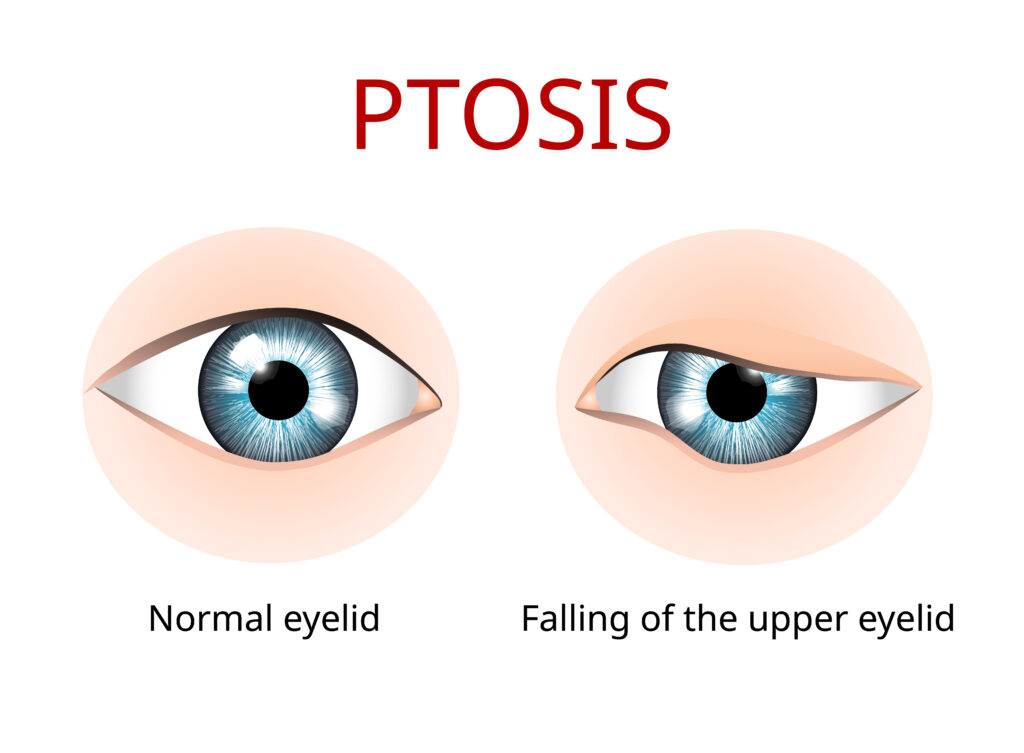
UNDERSTANDING PTOSIS
When the eyelid margin sits too low
Ptosis is the medical term for drooping of the upper eyelid. It may affect one or both eyes and can range from a subtle asymmetry to an eyelid that blocks part of the pupil and upper visual field.
Common symptoms
- Difficulty keeping the eyes open
- Reduced upper visual field
- Eyestrain or forehead aching
- Raising the eyebrows to see better
- Tilting the head back or lifting the lid
- A tired or asymmetric appearance
Possible causes
- Age-related stretching of the eyelid-lifting tendon
- Prior cataract or other eye surgery
- Congenital eyelid-muscle weakness
- Trauma
- Neurologic or muscular conditions
Sudden ptosis needs prompt evaluation
A new drooping eyelid—especially with double vision, unequal pupils, weakness, severe headache, or other neurologic symptoms—should be evaluated urgently rather than treated as a cosmetic concern.
THE CONSULTATION
Finding the cause guides the repair
- Measurement of eyelid height and levator muscle function
- Comparison of both eyelids, brows, and facial symmetry
- Pupil and eye-movement examination
- Dry-eye and ocular-surface assessment
- Visual-field testing and photographs when vision is affected
- Review of prior eye surgery, contact-lens wear, and neurologic symptoms
The evaluation also determines whether excess skin, brow droop, or another condition is contributing.
SURGICAL APPROACHES
Internal or external ptosis repair
Internal approach
The repair is performed through the underside of the eyelid, so there is no visible skin incision. It may be suitable for selected types and degrees of ptosis.
External approach
An incision is placed in the natural eyelid crease so the levator tendon or muscle can be tightened or reattached. This approach is often needed for greater or more complex ptosis.
A plan based on your measurements
Your surgeon chooses the approach based on eyelid height, muscle strength, anatomy, prior surgery, and desired functional improvement.
RECOVERY
What to expect after ptosis surgery
Bruising and swelling
Visible bruising and swelling commonly improve over one to two weeks. Mild swelling and eyelid-position changes may continue as tissues heal.
Ocular-surface care
Temporary dryness, irritation, or incomplete closure can occur. Lubricating drops or ointment may be recommended while the eyelid adjusts.
Activity restrictions
Avoid heavy lifting, deep bending, strenuous activity, and rubbing the eyelids until your surgeon clears you.
Final position
Eyelid height and contour evolve as swelling resolves. Follow-up visits allow your surgeon to monitor symmetry, closure, and healing.
RISKS AND EXPECTATIONS
Improvement—not perfect symmetry
Every face has natural asymmetry, and eyelid position can change during healing. The goal is meaningful improvement in eyelid height and function, but exact symmetry cannot be guaranteed.
- Dry eye, irritation, or exposure symptoms
- Bleeding, infection, or scarring
- Eyelid height that is higher or lower than intended
- Contour differences or asymmetry
- Temporary difficulty closing the eye
- Recurrence or need for revision
- Rare vision-threatening complications
Blepharoplasty may also be needed
Ptosis repair raises the eyelid margin but does not remove all excess upper-eyelid skin. When both problems are present, procedures may be combined after a complete evaluation.
FREQUENTLY ASKED QUESTIONS
Questions about ptosis repair
Is ptosis surgery cosmetic or functional?
It may be either. When the drooping eyelid blocks vision and required documentation meets insurance criteria, coverage may be possible. Cosmetic treatment is generally self-pay.
Will there be a visible scar?
An internal repair has no visible skin incision. An external repair uses the natural eyelid crease to help camouflage the scar.
How long will swelling last?
Most visible bruising and swelling improve over one to two weeks, but smaller changes can persist for several weeks or longer.
Where are consultations available?
Ptosis consultations are available through our Avon, Lakewood, Fairview Park, and Middleburg Heights offices.
NEXT STEP
Find out what is causing your drooping eyelid
A detailed examination can distinguish ptosis from excess skin, brow droop, or another eye or neurologic condition.
Individual outcomes and recovery vary. Your surgeon will review candidacy, risks, benefits, and alternatives during consultation.