PATIENT EDUCATION
Refractive Errors: Myopia, Hyperopia, Astigmatism & Presbyopia
Refractive errors are the most common reason vision is blurry. A precise examination identifies where focus is falling and which correction best fits your needs.
HOW FOCUS WORKS
Clear vision requires light to focus on the retina
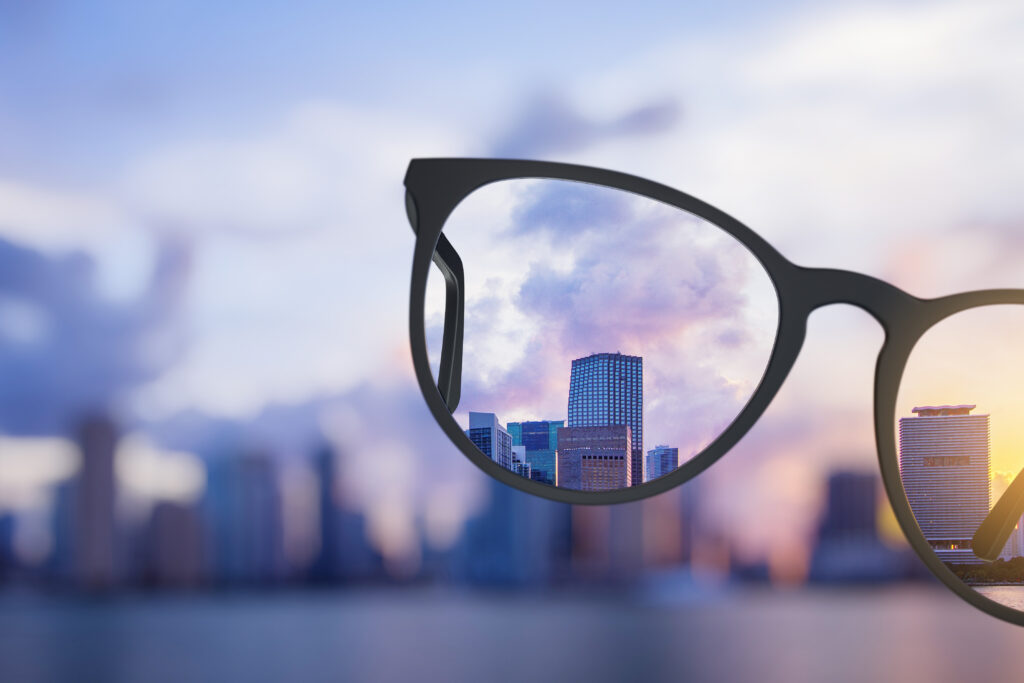
The cornea and natural lens bend light so it focuses on the retina. A refractive error occurs when the eye’s length, corneal curvature, or lens power causes light to focus in the wrong place or unevenly.
Blur from refractive error can usually be corrected with glasses, contact lenses, or—when appropriate—vision-correction surgery.
FOUR COMMON TYPES
Where and how vision becomes out of focus
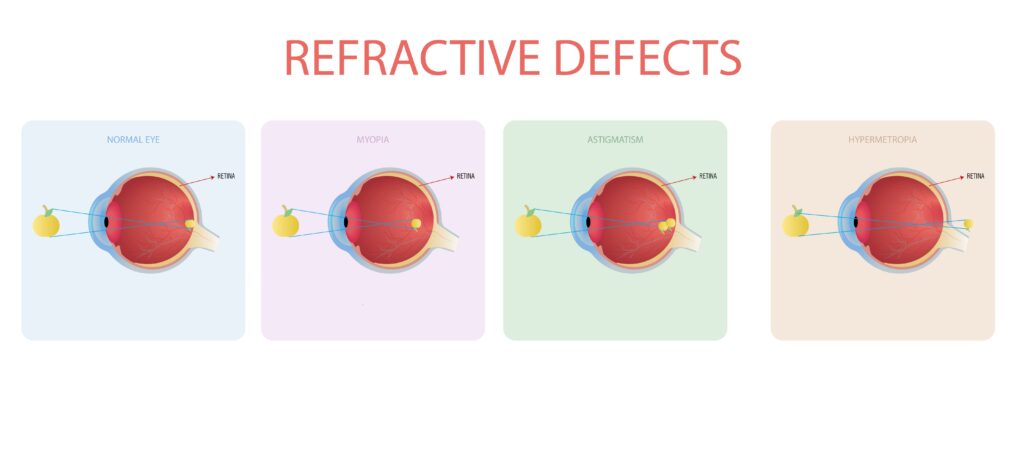
Myopia (nearsightedness)
Distant objects are blurry because light focuses in front of the retina. Higher myopia can also increase the risk of certain retinal conditions.
Hyperopia (farsightedness)
The eye must use extra focusing effort, especially at near. Depending on age and degree, both distance and near vision may be affected.
Astigmatism
Uneven corneal or lens curvature focuses light in more than one direction, creating blur, ghosting, glare, or distortion at any distance.
Presbyopia
The natural lens becomes less flexible with age, making near focusing difficult. It usually becomes noticeable in the 40s and is separate from farsightedness.
Possible symptoms
- Blur at distance, near, or both
- Squinting
- Eye strain or tired eyes
- Headaches with visual tasks
- Glare or halos
- Difficulty changing focus between distances
- Holding reading material farther away
- Trouble driving at night
YOUR EYE EXAM
A refraction measures the focusing correction
Your clinician may begin with an automated estimate, then refine the prescription by comparing lenses through a phoropter. The examination also checks eye alignment, focusing ability, and ocular health because cataract, corneal disease, dry eye, retinal disease, and other conditions can also cause blur.
A prescription is only one part of a comprehensive eye examination. Sudden blur, distortion, flashes, floaters, pain, or loss of side vision should not be assumed to be a glasses problem.
CORRECTION OPTIONS
Choose correction around your eyes and daily activities
Eyeglasses
A flexible, noninvasive option for all common refractive errors. Single-vision, bifocal, progressive, occupational, and specialty lenses serve different needs.
Contact lenses
Soft, rigid gas-permeable, toric, multifocal, and monovision options may provide a wider field of view. Healthy wear depends on proper fit and care.
LASIK and laser vision correction
Laser surgery reshapes the cornea to reduce dependence on glasses or contacts. Candidacy depends on prescription stability, corneal measurements, dry eye, and ocular health.
Lens-based correction
Cataract surgery and selected refractive lens procedures can address focusing needs with different intraocular lens options. Benefits and tradeoffs vary.
COMMON QUESTIONS
Refractive error FAQ
Does wearing glasses make eyes weaker?
No. Glasses focus light more clearly; they do not weaken the eyes or create dependence.
Why does my prescription change?
Growth, aging, lens changes, blood-sugar fluctuations, pregnancy, dry eye, medication, and eye disease can all affect measurements.
Can LASIK treat presbyopia?
LASIK does not restore the natural lens’s flexibility. Monovision may reduce the need for reading glasses in selected patients.
Why is vision still blurry with new glasses?
The prescription may need refinement, or an ocular-surface, corneal, lens, retinal, or neurologic condition may be contributing.
PATIENT EDUCATION VIDEO
Learn more about refractive errors
This video provides general education and does not replace an eye examination or individualized medical advice.
THE EYE CENTERS
Could your vision be clearer?
A comprehensive examination can determine whether glasses, contacts, LASIK, or another option best fits your eyes and visual goals.